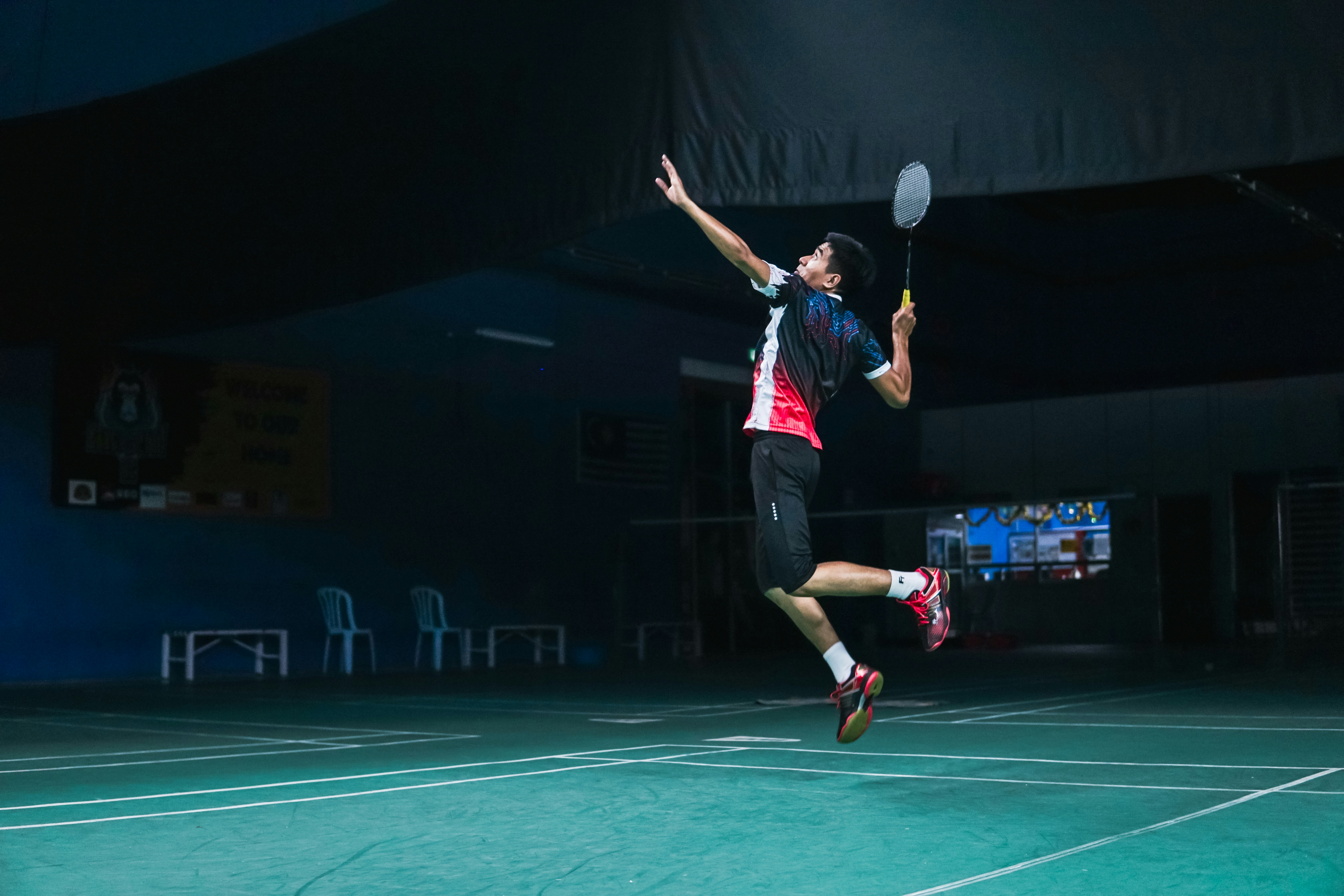
These are just a few examples of the various shots used in badminton. Players often employ a combination of these shots to deceive opponents and gain an advantage during a match:
1. Clear: A high shot hit deep into the opponent's backcourt to create space and buy time.
2. Drop Shot: A soft shot hit close to the net to make the shuttlecock fall rapidly and close to the net on the opponent's side.
3. Smash: A powerful overhead shot hit with force to send the shuttlecock downwards and quickly towards the opponent's court.
4. Drive: A fast and flat shot hit parallel to the net, traveling quickly over the net and keeping the opponent on the defensive.
5. Net Shot: A delicate shot played close to the net, usually to catch the opponent off guard and force a weak return.
6. Lift: A shot played from the backcourt that sends the shuttlecock high and deep into the opponent's backcourt.
7. Block: A defensive shot played to intercept and redirect the opponent's shot with minimal swing or power.
8. Slice: A shot with side-spin, where the racket cuts across the shuttlecock to create a spinning effect.
9. Reverse Slice: A shot where the shuttlecock is hit with an opposite spin compared to a regular slice shot.
10. Flick: A quick wrist action used to surprise the opponent by hitting the shuttlecock with a sudden burst of speed.
11. Drive Serve: A low and fast serve aimed to pass just over the net and travel to the opponent's backcourt.
12. Short Serve: A serve that lands close to the net, forcing the opponent to play a tight net shot.
Men Singles: Viktor Axelsen vs Brian Yang | Exhibition Match | Markham Pan Am Center, Canada 2022
Men Singles: Lakshya Seb vs Viktor Axelsen
Men Singles: Lee Zii Jia vs Anders Antonsen
Men Doubles: World Champion vs Top Amateur - Li Junhui Takes You to Know the Pattern Badminton
Training Badminton Match
Proper Racket Grip for Forehand and Backhand, Swing, Footwork, and Short and Long Serves
Perfect Badminton Low Serve Every Time - Best Method
The 4 Best Serves to Play in Men's Doubles - Badminton Strategy
Badminton Tips and Techniques - Returning the Serve
In badminton singles, aim for all four corners to tire out your opponent.
4 Corners Badminton Footwork Basics
Beginner's Guide to Backcourt Footwork
4 Corners Badminton Practice Training
Footwork Training (with English Subtitles)
Top Footwork Training for Pro Badminton Players
This New Serve Could Change Badminton Forever
20 Min Basic Racket Skill Session at Home | Beginner Friendly
Backhand Clear Shot
Backhand Slice Shot (with English Subtitles)
Tips: Grip Edge Side
Smash and Clear Tutorial: Get More Power in Your Overhead Shots
Powerful Smash Tips
Badminton Forehand Smash Training
Viktor Axelsen: Best Tips to Improve Your Smash
3 Keys to Maximize Your Smash Power
Backhand Smash (with English Subtitles)
Defense Against the Smash: Block Defence and Lift Defence
Badminton Smash Defence Training
Defense in Doubles
Tactical Formation in Doubles: Smash, Move In, and Kill
Net Play, Net Shot, and the Grip
Low-Angle View: Malaysia Final - Tai Tzu Ying vs An Se Young
#1 The Tai Tzu Ying Backfire Shot
#2 Lobbed Drop Shot
#3 Behind the Back Trick Shot
#4 Cross Court Drive (Late Forehand)
#5 Cross Court Drive (Late Backhand)
#6 Indecisive Backhand Save from Low Position
#7 Reverse Slice Straight Drop (Forehand)
#8 Reverse Slice Straight Drop (Backhand)
#9 Reverse Slice Straight Drop with Full Pirouette (Backhand)
#10 Reverse Slice Smash (Forehand)
#11 Hold and Flick (Backhand)
#12 Hold and Flick with Vertical Racket Head (Backhand)
#13 Hold and Flick Cross Court (from Forehand)
#14 Forehand Disguised Net Shot with same action as Hold & Flick
#15 Hold and Flick Cross Court (from Backhand)
#16 Cross Court Backhand Smash
#17 Straight Backhand Smash
#18 Counter Attack, Forehand Cross Court Drive
#19 Straight Push with Reverse Slice (Forehand)
#20 Straight Return Drive (Forehand)
#21 Between the Legs Trick Shot
#22 Net Kill (Backhand)
#23 Net Kill (Forehand)
#24 Smash & Kill with turn of the Racket Head
#25 Perfect Spinning Net Shot (Backhand)
#26 Disguised Slow Drop (Forehand)
#27 Backhand Cross Court Drop Shot
#28 Wrist-Only Forehand Cross Drop
#29 Cross Court Backhand Clear
#30 Low Forehand Clear
#31 Double Action Net Shot (Forehand)
#32 Double Action Net Shot (Backhand)
#33 Pace Off Drop Shot (Forehand)
#34 Pace Off Drop Shot (Inside out forehand from Backhand Side)
#35 Disguised Net Shot (from Forehand Front Court)
#36 Cross Court Net Shot (Low Backhand)
#37 Cross Court Net Shot (Low Forehand)
#38 Forehand Cross Net Shot with Dive
#39 LCW Type Low Backhand Net Shot
#40 Double Cross Net Shot
#41 Insane Reflexes
#42 Cross Court Defence (Backhand)
#43 Cross Court Defence (Backhand) with Full Pirouette
#44 Cross Court Defence (Forehand)
#45 Ridiculous Crouched Defence
#46 Stick Smash from Round-the-Head
#47 Sideways Drift Control
#48 Anticipation/Guessing
#49 Excellent Shuttle Control (Net Shot while the Shuttle is Tumbling)
#50 Net Cord on a Net Cord
Badminton Stretch: These four videos cover various stretches for badminton. For your case, you may create your own stretch routine based on those demonstrated in the videos. Just omit some of the more difficult ones.
Badminton Racket Weight is categorized by U:
2U -> Heavy
3U -> Common
4U -> Common
5U -> Light
6U (F) -> Super Light
7U (2F) -> Ultra Light
Badminton Racket Grip Size is categorized by G:
G4 -> common (thicker)
G5 -> common (thinner)
G6 -> thin
G7 -> ultra thin
Badminton Factory 2023: Rackets & Shuttlecock Production Line – Manufacturing Process
You can restring your badminton racket from 20-22lbs to 25-27lbs, and even up to 28-30lbs, as you progress from a beginner to a skilled player, allowing for more powerful smashes.
Badminton strings vary in terms of material, construction, and playing characteristics. Here's a brief overview of the strings you mentioned:
1. BG65:
* Type: Durable, all-around string.
* Characteristics: Offers good durability and playability.
2. BG65 Titanium:
* Type: Similar to BG65 but with added titanium coating.
* Characteristics: Improved durability and repulsion.
3. Nanogy95:
* Type: Control-oriented string.
* Characteristics: Provides a good balance of control and power.
4. Nanogy99:
* Type: High-repulsion string.
* Characteristics: Offers excellent repulsion for aggressive play.
5. BG80:
* Type: Control-oriented, high-repulsion string.
* Characteristics: Known for its crisp feel, control, and power.
6. BG80 Power:
* Type: Similar to BG80 but with enhanced power. An upgraded version of BG80, offering even more power and durability.
* Characteristics: Combines power with control.
7. SKYARC:
* Type: High-performance string.
* Characteristics: Designed for power and repulsion.
8. EXBOLT65:
* Type: Durable all-around string.
* Characteristics: Offers good durability and playability.
9. EXBOLT63:
* Type: Durable string with a focus on repulsion.
* Characteristics: Provides durability and repulsion for attacking play.
10. BG66:
* Type: High-repulsion string. Offers a soft feel and great repulsion, suitable for players who want a good balance.
* Characteristics: Offers excellent repulsion for quick shots.
1. Undue delay
2. Too high: 1.15m
3. Some part of both feet must remain in contact with the surface of the court in a stationary position from the start of the service until the service is delivered. (This means the player cannot lift any part of their feet off the court surface until the service is executed. However, lifting only the heel is permissible.)
4. Service not in one motion
5. The server's racket should initially hit the base of the shuttle
What Are the Faults in Badminton?
Over the Net Fault https://masterbadminton.com/badminton-fouls.html#ove-fault
Tip: You can only take the shuttle after it has fly over to your side. Not a fault because you take the shuttle after it crosses the net. You are also allowed to follow through with your racket after you hit the shuttle. Even if your racket crosses over to your opponent’s side, it is fine. To sum things up, you are NOT allowed to take the shuttle when it’s still on your opponent’s side. As long as you obey this, your racket can go over the net.
This example illustrates a situation that players frequently misunderstand: If Player A put his racket right above the net against Player B's return was a fault. It’s a subtle distinction.
In the rule: "He (A) is not allowed to block your (B) stroke (the movement of your racket), but he (A) is allowed to block your (B) shot (the movement of the shuttle). If your opponent (A) obstructs this — such as putting his (A) racket in the way so that you (B) would be forced to hit it (his racket here) — then you (B) win the rally. Your opponent (A) is allowed to put his racket in the path of the shuttle" (he can put his racket close to the net and above the white tap of the net.) There is a legal scenario in which your (B) racket contacts shuttle on your side but part of your racket head goes over the net (his side). But it's not your fault. Because "you are allowed to follow-through with your racket over the net, providing you made contact on your side."
I would make it simple: He (A) can do that as he did. But if your (B) racket hits his (A) racket on his side when you (B) make a legal stroke, then that's his fault, whereas if your racket doesn't hit his racket when you make a legal stroke, then it's not his fault as well as not your fault (But well, in the latter scenario he still wins the rally if the shuttle bounces from his racket to the ground on your side.)
We are committed to shaping a brighter future for everyone through the transformative power of technology and innovation.
In a rapidly changing world, the advancing capabilities of Artificial Intelligence (AI) and Robotics are reshaping the landscape of work. Looking ahead, we envision a future where humanity thrives through collaboration, creativity, and shared knowledge. The era of pursuing wealth, influence, and vanity as the epitome of success is behind us. Instead, we believe that by harnessing the collective wisdom of individuals, we can foster equality, world peace, and prosperity for generations to come.
Join us on a journey towards a more inclusive and sustainable world, where everyone has the opportunity to contribute, learn, and grow.